Servers, Sovereignty, and Downtime: The IT Infrastructure Relocation Guide UK Tech Teams Cannot Afford to Skip
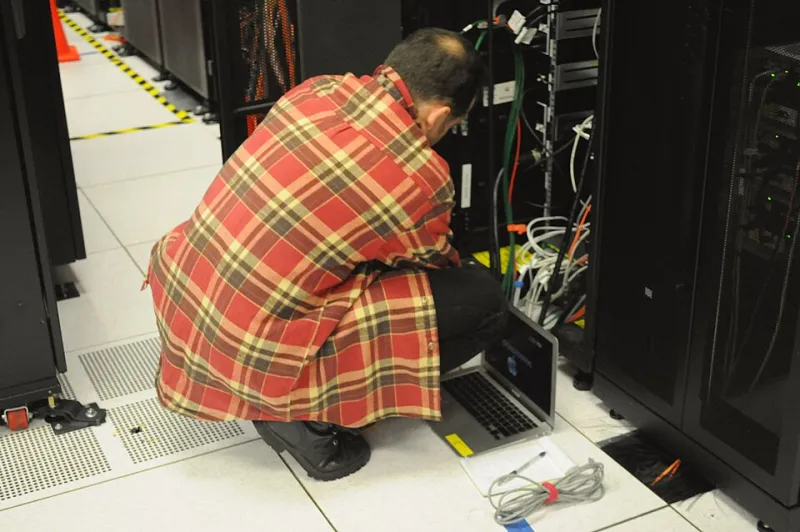
Photo: Derrick Coetzee from Berkeley, CA, USA, CC0, via Wikimedia Commons
For most UK businesses planning an international office move, the removal of desks, filing cabinets, and kitchen appliances follows a broadly familiar process. The relocation of IT infrastructure, however, is an entirely different undertaking—one that sits uncomfortably at the intersection of physical logistics, regulatory compliance, and cybersecurity risk. Yet it is precisely this intersection that tends to receive the least coordinated attention during international moves.
The consequences of poor planning are not merely operational. Mishandled server migrations can expose businesses to data protection enforcement, trigger contractual breaches with clients, and create security vulnerabilities that persist long after the last packing crate has been unpacked. For UK tech teams preparing to support a cross-border relocation, understanding what is at stake—and who is responsible for what—is essential groundwork.
Why Standard Removal Logistics Are Insufficient for IT Equipment
Reputable international removal companies are well-versed in protecting fragile items, managing customs documentation, and navigating import restrictions. What they are not, by default, equipped to manage is the regulatory and technical dimension of moving live or recently decommissioned IT infrastructure across national borders.
Servers, network appliances, storage arrays, and specialist computing hardware present challenges that go beyond fragility. They may contain encrypted or unencrypted data subject to GDPR or local data protection laws. They may be subject to export controls under UK strategic export licensing regulations or equivalent frameworks in the destination country. And the physical journey itself—potentially spanning multiple transit territories—introduces periods during which hardware is outside the direct control of the business, creating security exposure that must be actively managed.
The gap between what a removal specialist can offer and what an IT team actually needs is where costly miscommunication most frequently occurs. Bridging that gap requires deliberate coordination well before any equipment is powered down.
Data Residency Laws: Understanding Your Obligations Before You Pack
One of the most significant regulatory considerations in any international IT relocation is data residency—the legal requirement, in many jurisdictions, for certain categories of data to be stored and processed within specific geographic boundaries.
For UK businesses relocating to EU member states, the General Data Protection Regulation continues to apply, and the destination country may impose additional national requirements on top of the baseline framework. Relocating to markets such as Russia, China, India, or the Gulf states introduces even more prescriptive data localisation obligations, some of which carry significant penalties for non-compliance.
Before any physical relocation of servers or storage infrastructure, legal and IT teams should jointly conduct a data mapping exercise. This process identifies what data is held on which systems, whether that data is subject to residency requirements in either the origin or destination country, and whether the planned relocation creates any conflict with existing data processing agreements or client contracts.
In some cases, the most compliant solution is not to physically relocate on-premise hardware at all, but to migrate workloads to cloud infrastructure hosted in the destination territory prior to the move. This approach decouples the physical logistics from the data governance question and can significantly reduce both risk and downtime.
Cybersecurity During Transit: The Risk Window Businesses Underestimate
The period between a server being powered down at the origin site and being brought back online at the destination is arguably the highest-risk window in the entire relocation process. Hardware is physically accessible to third parties, chain of custody documentation may be incomplete, and the business has limited visibility of where its equipment is at any given moment.
For businesses operating under frameworks such as ISO 27001, Cyber Essentials Plus, or sector-specific standards applicable to financial services or healthcare, this transit period must be treated as a formal security event requiring documented controls.
Practical measures include full-disk encryption of all storage media prior to decommissioning, tamper-evident sealing of equipment cases, GPS tracking of freight consignments, and strict chain of custody protocols requiring signatures at each transfer point. Businesses should also consider whether any hardware contains credentials, cryptographic keys, or sensitive configuration data that should be wiped before transit and restored from secure backups upon arrival.
Where high-value or particularly sensitive infrastructure is involved, engaging a specialist secure logistics provider—rather than a general freight carrier—is a worthwhile additional investment.
Export Controls and Customs Classification: A Compliance Area Frequently Overlooked
Certain categories of IT equipment are subject to export controls under the UK Export Control Joint Unit (ECJU) framework, particularly where hardware incorporates encryption technology above specified thresholds or falls within dual-use goods classifications.
Networking equipment, cryptographic appliances, and some categories of server hardware may require an export licence before they can lawfully leave the UK. Destination countries may impose equivalent import controls. Failure to obtain the correct licences can result in equipment being detained at customs, significant financial penalties, and reputational damage.
IT teams should work with their legal advisers and, where appropriate, with their removal specialist's customs team to classify all equipment accurately under the UK Global Tariff and identify any applicable controls. This process takes time and should not be left until the week before the planned move date.
Coordinating IT Vendors, Removal Specialists, and Internal Teams
Successful IT infrastructure relocations depend on a level of cross-functional coordination that many businesses underestimate. The IT department, facilities management, legal, procurement, and the appointed removal company must all operate to a shared timeline with clearly defined handover points.
A structured project plan should establish when each system will be decommissioned, in what sequence equipment will be packed and collected, what the expected transit duration is, and when IT teams at the destination site will be available to receive and recommission hardware. Lead times for ordering replacement components or temporary cloud capacity should be factored in from the outset.
Vendor relationships also require proactive management. Maintenance contracts, warranty terms, and support agreements for server hardware and network equipment may be geographically restricted. A support contract valid in the UK may not automatically extend to a data centre in Frankfurt or Singapore, and lapses in vendor support during a transition period can leave businesses exposed.
Minimising Downtime: Phased Migration as Best Practice
For businesses that cannot tolerate extended periods of system unavailability, a phased migration approach is generally preferable to a single-event cutover. Under this model, non-critical systems are relocated first, allowing the IT team to validate processes and address unforeseen issues before mission-critical infrastructure follows.
Hybrid configurations—where some workloads run on temporary cloud infrastructure while physical hardware is in transit—can reduce the effective downtime window to hours rather than days. The additional cost of short-term cloud capacity is almost invariably less than the commercial impact of prolonged system unavailability.
Testing and validation protocols at the destination site should be agreed in advance, including clear acceptance criteria that must be met before the relocation is formally signed off as complete.
A Final Note on Accountability
Perhaps the most important structural decision in any international IT relocation is establishing a single point of accountability—an individual or team with the authority and remit to coordinate across all workstreams. Without this, the gap between logistics providers and tech teams tends to widen precisely when it most needs to close.
At International Removals Ltd, we work alongside IT departments and their appointed vendors to ensure that the physical logistics of an international office move are planned and executed in full awareness of the technical and regulatory requirements involved. The conversation between your removal specialist and your IT team should begin at the earliest planning stage—not on the day the first server is powered down.